PoC vs Prototype vs MVP: How to Choose the Right First Build
PoC vs prototype vs MVP at a glance
In the PoC vs prototype vs MVP decision, each artifact answers a different question at a different price. A proof of concept (PoC) tests whether a risky technical idea can work at all, typically in two to ten days for $1,500 to $5,000. A prototype shows how the product will look and feel so users and investors can react to the workflow, taking one to two weeks for $2,000 to $6,000. A minimum viable product (MVP) is live, working software that real customers use and pay for, taking two to ten weeks for $10,000 to $35,000.
Mixing up these three terms causes two classic startup headaches: showing a raw backend script to customers expecting a usable product, or spending $30,000 building a production MVP when a $3,000 clickable prototype would have revealed that buyers do not want the workflow. In CB Insights' review of 431 VC-backed startups that shut down since 2023, 43% failed because of poor product-market fit and 70% ran out of cash. Picking the cheapest artifact that tests your riskiest assumption keeps both numbers in check.
| Dimension | Proof of Concept (PoC) | Prototype | Minimum Viable Product (MVP) |
|---|---|---|---|
| Core question answered | Can this technology work? | Do users understand and want this flow? | Will customers use and pay for this in real life? |
| Primary audience | Internal engineers and technical founders | Target users, stakeholders, early angel investors | Paying customers and early adopters |
| Typical timeline | 2 to 10 days | 1 to 2 weeks | 2 to 10 weeks |
| Typical budget | $1,500 to $5,000 | $2,000 to $6,000 | $10,000 to $35,000 |
| Production readiness | Throwaway script or notebook | Figma screens or disposable UI mock | Deployed web or mobile app with auth and database |
| Success metric | Accuracy, latency, or API feasibility pass/fail | Task completion in 5-user usability sessions | Activation, retention, and paid conversion |
What is a proof of concept (PoC) and when do you need one?
A proof of concept is a small, isolated technical experiment built to answer a single binary question: is our hardest engineering assumption actually possible? A PoC has no sign-up screen, no billing page, and no polished interface. It often lives in a Jupyter notebook, a command-line script, or a single API route.
Most startups do not need a PoC. If you are building a B2B SaaS platform, a marketplace, or a booking tool using standard web databases, authentication, and payment APIs, thousands of companies have already proved that technology works. Spend zero dollars proving that PostgreSQL and Stripe can process an order.
You need a PoC only when your business model depends on an unproven technical leap. Common examples include:
- Testing whether a vision or language model can extract handwritten figures from noisy medical or logistics forms with at least 95% accuracy.
- Verifying that an undocumented legacy ERP or hardware sensor in a factory can stream real-time events without dropping packets.
- Benchmarking whether a custom routing or matching algorithm can solve a 10,000-node schedule in under two seconds.
Once the experiment passes or fails, archive the script and document what you learned. Never try to bolt a customer user interface onto a quick-and-dirty PoC script.
What is a prototype and what does it validate?
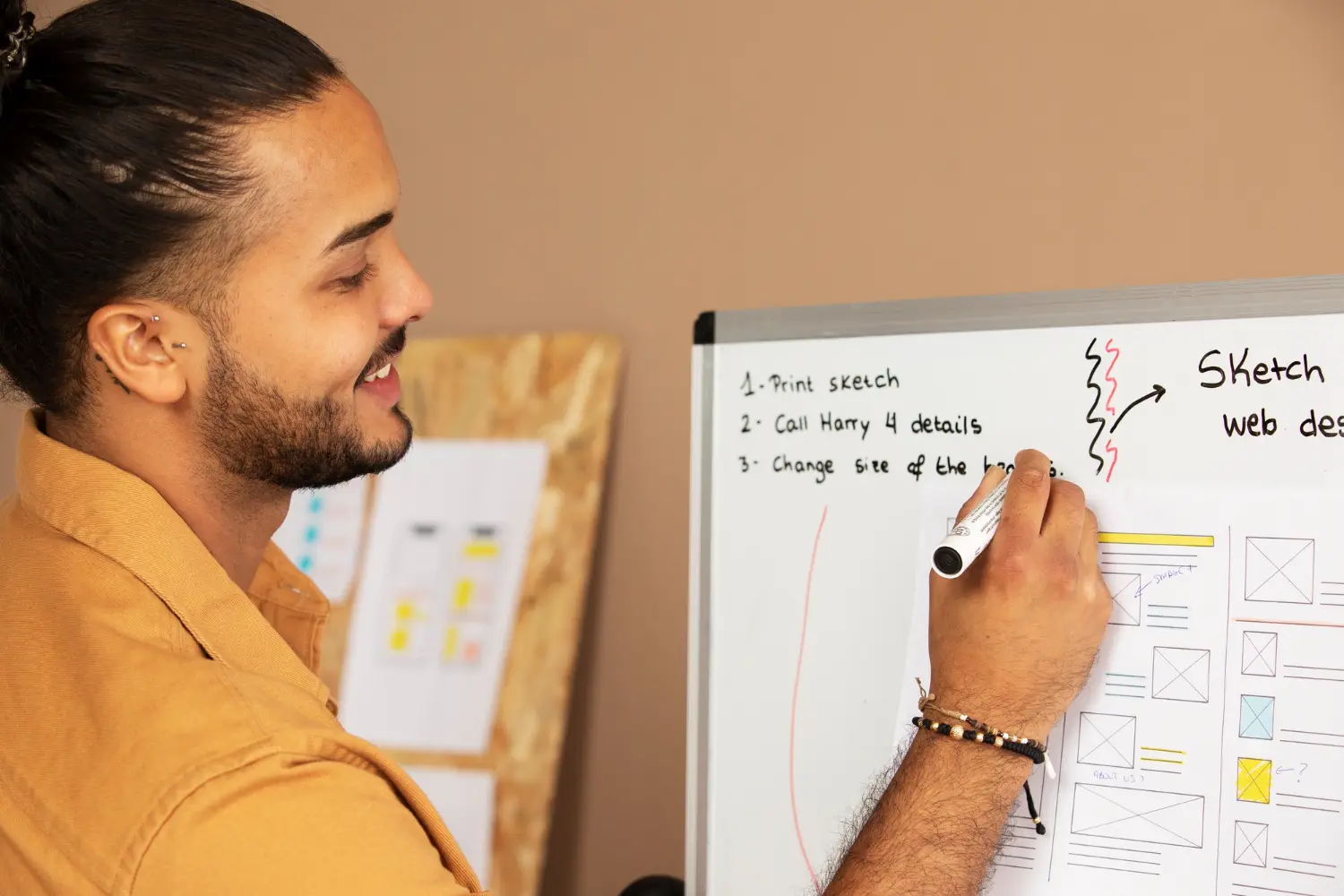
While a PoC lives under the hood, a prototype is all surface. It simulates the user experience of your product without building the database, security rules, or background workers behind it. A prototype can be a clickable Figma flow or a front-end mock generated in a day with an AI UI tool. For a closer look at formats and fidelity levels, read our knowledge base guides on prototyping techniques and rapid prototyping.
The goal of a prototype is to test comprehension and workflow friction before you pay for backend engineering. Usability researcher Jakob Nielsen showed in studies at the Nielsen Norman Group that watching just five target users walk through a prototype uncovers roughly 85% of usability problems in that flow.
In a 30-minute prototype session, give the participant a realistic scenario and watch where they hesitate. Do they understand what the dashboard numbers mean? Do they look for an export button that does not exist? Fixing a confusing workflow in Figma takes twenty minutes. Fixing that same workflow after database tables, API endpoints, and automated tests are written takes days.
Prototypes test usability and interest, not retention
A clickable Figma prototype can tell you whether five prospects understand your value proposition and want a pilot. It cannot tell you whether they will log in three times a week or keep paying in month three. Only a live MVP can measure retention.
What is a minimum viable product (MVP)?
A minimum viable product is the smallest version of your real software that delivers the core outcome to actual users in production. Unlike a PoC or a prototype, an MVP has real authentication, a persistent database, basic security controls, error tracking, and a way to capture revenue or binding usage commitments.
Crucially, an MVP is still much smaller than a full version-one product. Pendo's 2019 Feature Adoption Report across 615 software subscriptions found that 80% of features in the average software product are rarely or never used, while 12% of features generate 80% of daily usage. An MVP isolates that 12% core loop and ships it in weeks so you can learn from real behavior instead of hypothetical survey answers.
In our MVP outsourcing practice, fixed-scope MVPs sit in three clear tiers: $10,000 for MVP Lite (2 to 3 weeks, single core workflow), $20,000 for MVP Standard (5 to 6 weeks, multi-role B2B workflow with payments and integrations), and $35,000 for MVP Pro (8 to 10 weeks, multi-tenant or AI-enabled architecture). You can see how those budgets break down in our MVP development cost guide.
Decision framework: should you start with a PoC, prototype, or MVP?
Founders often assume they have to run all three stages in strict sequence. In practice, you only run the stages where you have genuine uncertainty. Use these four rules to pick your starting point during product discovery:
Rule 1: Start with a PoC only if technical feasibility is unknown
If your product relies on custom AI accuracy over messy private data, novel hardware communication, or a strict cryptographic constraint, spend one week and under $5,000 on a PoC first. If it uses standard web, mobile, or cloud APIs, skip the PoC completely.
Rule 2: Start with a prototype when workflow clarity or fundraising comes first
If you are translating a complex offline industry process into software, or if you need tangible screens to secure pre-seed commitments and letters of intent from B2B buyers, build a prototype in one to two weeks and test it with five to ten users.
Rule 3: Go straight to a lean MVP when the problem and pattern are already proven
If you have already validated demand through customer interviews, manual concierge delivery, or pre-sales, and the interface follows familiar SaaS or marketplace patterns, move directly into a focused two-to-six-week MVP build. We cover pre-code demand tests in how to validate an MVP before development.
Rule 4: Combine PoC + prototype in parallel for AI products
For an AI startup, the smartest two-week sprint runs two small tracks at once: an engineer tests prompt and retrieval accuracy on 50 real documents (the PoC), while a designer tests the human-in-the-loop review screen with five target users (the prototype). Once both pass, you build the MVP with high confidence.
Unsure whether you need a PoC, prototype, or full MVP?
Bring your idea to a discovery call. We will tell you honestly which stage tests your riskiest assumption for the least money.
Book a discovery callHow 2026-2027 AI tools blur the line between prototype and MVP
Heading into 2027, AI app builders and coding assistants have changed the economics of prototyping. A founder can now type a prompt and generate a working front-end with sample data in an afternoon instead of wiring static Figma arrows. That speed is a major advantage for early user interviews, and we recommend using it.
At the same time, this convenience has created a new trap: mistaking an AI-generated prototype for a production MVP. In May 2025, the US National Vulnerability Database published CVE-2025-48757, detailing how applications generated with the AI builder Lovable shipped with insufficient database row-level security policies that allowed unauthenticated attackers to read and write private user tables.
When you move from testing a prototype with five friendly interviewees to storing real customer records and taking payments in an MVP, the software needs real access-control rules, server-side validation, automated tests, and clean architecture. Read our guide on AI-assisted MVP engineering and our MVP development process guide to see how we pair fast AI prototyping with production-grade engineering.
Real-world examples: how three startups sequenced PoC, prototype, and MVP
Looking at how three different startup types sequence these artifacts makes it much easier to plan your own calendar and budget.
Scenario A: B2B construction procurement SaaS (Skipped PoC, built prototype + MVP)
A two-founder team wanted to replace email and spreadsheet subcontractor bids for mid-sized general contractors. Because the workflow used standard web forms, PDF parsing, and PostgreSQL tables, there was zero technical feasibility risk. They skipped the PoC completely, spent $3,000 and eight days building a clickable Figma prototype, and tested it on Zoom with seven construction project managers. Those sessions exposed that subcontractors needed to submit bids from a mobile browser without creating a password first. Armed with that insight, the founders built a $20,000 MVP Standard web app in six weeks and signed four paying contractors in month one.
Scenario B: AI medical coding assistant (Ran 1-week PoC + prototype in parallel, then MVP)
A clinician founder wanted to extract billing codes automatically from messy outpatient clinical notes. Here, the business lived or died on extraction accuracy. The team spent five days and $2,500 on a Python PoC script testing three foundation models and a hybrid retrieval pipeline against 100 anonymized notes. Once precision crossed 92% with inline source highlighting, they ran a five-user clickable prototype test with medical billers to verify the side-by-side review screen, then funded a $35,000 MVP Pro build over nine weeks.
Scenario C: Consumer fitness hardware companion (Required all three stages in sequence)
A hardware startup building a Bluetooth rowing sensor had to prove first that low-energy Bluetooth packets stayed synchronized on both iOS and Android without draining the phone battery. They built a raw two-week mobile PoC binary to benchmark packet loss, followed by a clickable prototype of the workout summary screens, before committing to a cross-platform React Native MVP.
Three expensive stage-selection mistakes to avoid
- Pitching a PoC to non-technical buyers: Showing a terminal window or raw JSON output to a VP of Operations rarely wins a pilot. Wrap technical proofs in at least a simple three-screen prototype before showing business buyers.
- Deploying prototype code to production: Treating a hackathon mock with hardcoded credentials and no database migrations as your live MVP guarantees painful outages the week real traffic arrives.
- Turning an MVP into a full product before launch: Packing twelve secondary features into your first release turns a six-week MVP into a six-month build. See how to draw the boundary in our comparison of MVP vs full product development.
Tags