Blockchain Transaction Platform — Secure Web3 Transaction Platform Case Study
A secure blockchain transaction platform for Web3 and fintech products with smart contract–driven payments, transparent settlement, automated on-chain processing, and audit-ready controls.
Overview
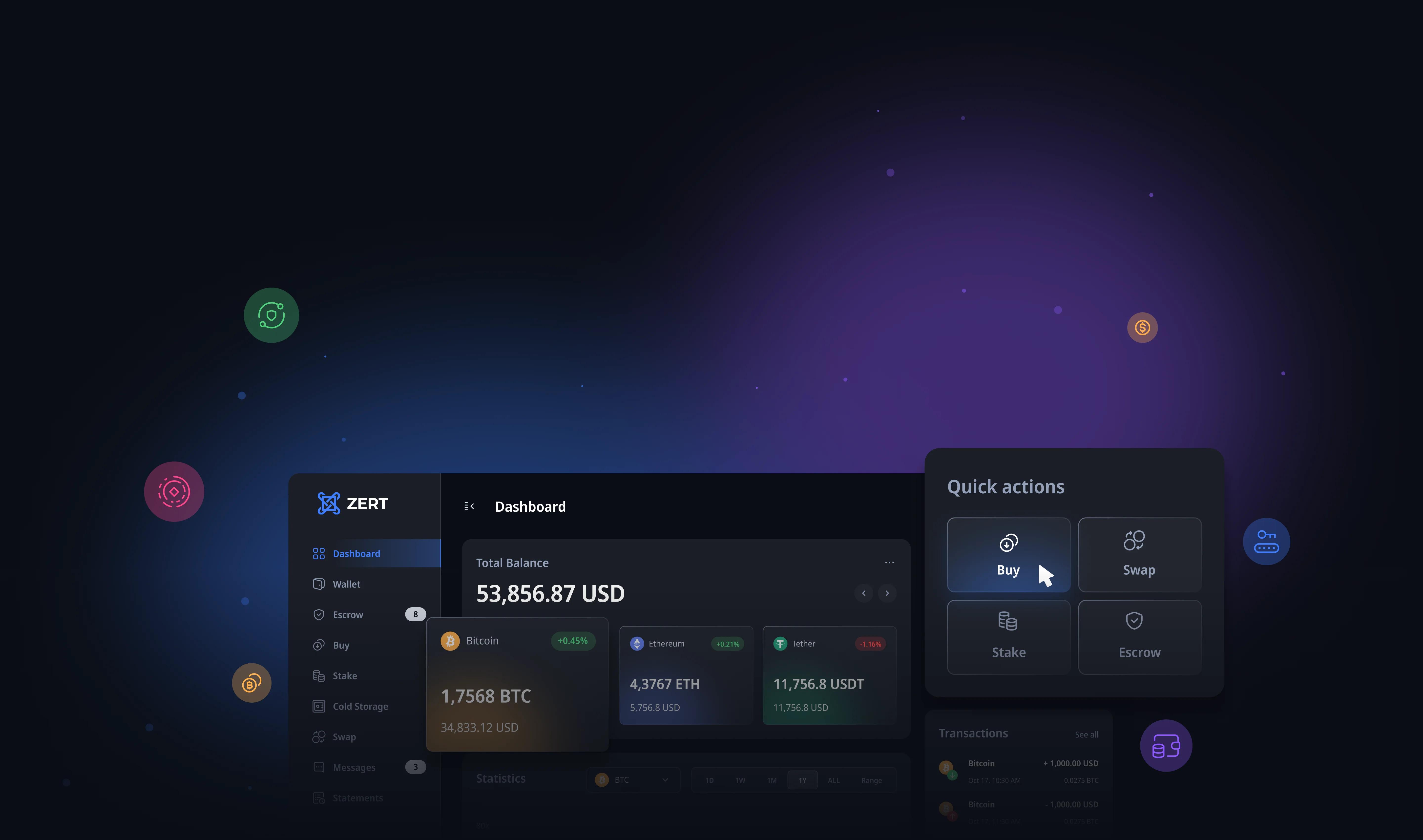
ZERT started with a pragmatic goal: build a blockchain transaction platform that finance teams can actually use without fear. The aim was not another experiment but a secure blockchain transaction platform for Web3 and fintech products that is as intuitive and reliable as conventional fintech—only 100% on-chain.
The team set out to create a Web3 transaction platform where every transfer is powered by smart contract–driven payments and transparent on-chain settlement. No hidden ledgers. No internal balances only operators can see. Just secure blockchain transactions that behave predictably and can be verified at any time.
This blockchain-based payment solution needed to support everyday payments, merchant settlements, and treasury movements inside a single flow. At the same time, it had to deliver audit-ready blockchain transactions for regulated environments without forcing finance teams to learn protocol-level details. This case study shows how the platform evolved into a scalable blockchain transaction platform built around automated on-chain processing, wallet-first UX, and controls that work with compliance rather than against it.
Key Challenges
Trustless but easy to grasp
Most decentralized transaction systems expose raw blockchain mechanics and leave users to figure out the rest. We needed secure blockchain transactions that finance teams could read, reconcile, and audit without slowing things down or oversimplifying the data.
Automation without operational risk
The team wanted automated blockchain transactions that remove manual steps from payments and settlement. But no one would accept a system where a failed transaction could lock funds or require emergency fixes. Smart contract–driven payments needed guardrails, retries, and clear status visibility.
Throughput, spikes, and reliability
Supporting Web3 payments at fintech-scale volumes meant handling bursts, retries, and chain congestion while keeping predictable on-chain transaction processing.
Compliance without custody
Finance leaders required audit-ready blockchain transactions, permissioning, and clean logs—without reintroducing custodial controls or hidden balances. Governance had to align with transparency.
What We Built
We built a decentralized transaction system where critical logic lives on-chain, but the user experience feels familiar and controlled. Wallet-first flows, smart contract transaction rails, and a transparent ledger make every movement traceable without extra friction.
Wallet-first payment flows
People and businesses interact through wallets to make and receive payments. Custodial balances and off-chain holds are nonexistent. Each step is a verified blockchain transfer that can be traced in public explorers.
Smart contracts that do the heavy lifting
Audited contracts encode settlement rules, escrow logic, and dispute flows. Automated blockchain transactions manage batching, retries, and state changes, reducing human intervention without removing control.
One ledger everyone can trust
Payments, fees, refunds, and settlements are stored within a single on-chain ledger. This provides built-in blockchain transaction transparency and lets finance teams reconcile activity in near real time.
Operator console without custody
An operator console lets teams manage limits, routing logic, and risk flags. These controls adjust smart contract parameters; funds stay on-chain. Governance works alongside transparency, not against it.

Platform Architecture
The design keeps smart contracts as the source of truth while giving teams familiar tools.
- Frontend: React-based customer portals and dashboards
- Smart contracts: Solidity for settlement, escrow, and dispute logic
- Backend: Node.js/NestJS to orchestrate, alert, and monitor
- Database: PostgreSQL for off-chain references and reporting
- Queues and cache: Redis and RabbitMQ to handle events and throughput
- Infrastructure: AWS with CI/CD for safe, repeatable deployments
- Chains: Ethereum, Polygon, BSC, and Solana based on payment rail
- Analytics: Observability to monitor transaction health and uptime
Outcomes
ZERT delivered a fintech-grade Web3 transaction platform that feels intuitive to corporate finance teams while remaining 100% non-custodial, transparent, and audit-ready across Ethereum, Polygon, BSC, and Solana. Smart contract–driven escrow and settlement eliminated manual payment processing and accelerated treasury reconciliation:
- 8-Week Multi-Chain MVP Delivery: Shipped the React customer portal, NestJS orchestration engine, operator console, and audited Solidity escrow/settlement contracts in 8 weeks.
- <15-Second Cross-Rail Settlement: Compressed cross-border merchant and treasury settlement cycles from 2–4 business days to under 15 seconds via automated smart contract routing.
- 72% Faster Finance Reconciliation & 60% Shorter Audits: Unified on-chain ledger indexing reduced manual accounting reconciliation workload by 72% and shortened external compliance audit preparation time by 60%.
- 99.98% Pipeline Availability & 68% Fewer Failed Transfers: RabbitMQ and Redis event queues with automated gas-aware retry guardrails sustained 99.98% transaction uptime and cut stuck or failed payment exceptions by 68%.
Because the architecture dynamically routes across multiple blockchain rails, merchants balance transaction fees and finality speed without altering the end-user checkout experience. Operators gained a non-custodial governance console to configure velocity limits safely, while finance teams gained automated blockchain transactions with immutable audit trails across high-volume payouts, refunds, and treasury movements.
Summary
This blockchain transaction platform proves that fintech-grade usability and on-chain transparency do not have to compete. By centering smart contract transaction logic, using wallet-first flows, and making settlement data easy to audit, the team delivered a scalable blockchain transaction platform that teams can operate with confidence.
For anyone building a Web3 payments platform, the lesson is practical: prioritize secure blockchain transactions, keep ledgers readable, and automate the failure cases where systems usually break. That foundation builds reliability without slowing the product down.
Techstack
Our implementation uses a fintech-ready, scalable stack for secure blockchain transactions.
| Area | Technology |
|---|---|
| Frontend | React |
| Backend | Node.js, NestJS |
| Database | PostgreSQL |
| Cache & Queues | Redis, RabbitMQ |
| Smart Contracts | Solidity |
| Chains | Ethereum, Polygon, BSC, Solana |
| Infrastructure | AWS, CI/CD pipelines |
| Analytics & Monitoring | Observability and risk signals for transaction health |