MVP Test: How to validate a minimum viable product

Introduction
You must be aware that it is worth to build a new product before you build it. We must have heard the entire 9 in 10 startups fail schism. And now you see you get into the other 10%. To accomplish such, you create an MVP and test it. An MVP test is aimed at early validation of your idea by the means of a minimum viable product. You do not release a full product but publish a basic one to test one of the main assumptions. This provides you with a fast user feedback enabling you know whether your idea will solve a real problem to your target audience. But it is not as easy said and done. This paper will discuss the optimal approaches to MVP testing, tools, and strategies to test your MVP and proceed with certainty.
What is MVP validation
MVP validation is the technique of establishing the real need of your product idea, before you invest your efforts to create the actual version of your product. Beware, not every idea (at least not as it was presented in the beginning) is worth your time and life savings.
Validation of an idea can be done in other ways than through an MVP. Other than MVP, others are POC and prototypes.
What is MVP validation
It's not about polish. It's about learning. The MVP testing is aimed at ensuring that the users require what you are offering. That doesn't refer to opinions, it refers to real behavior. An effective minimum viable product has a single assumption. When that is not so, then the rest is irrelevant. Validation will save you the time and money you would have to spend on creating a product that no one desires. It also assists you to make sensible choices, and not to become emotionally involved to your idea.
Why should you test a minimum viable product
Testing MVP enables you to enter assumptions before investing in serious time and funds. It is a risk-free method of finding out whether or not your product idea has a future. Early MVP testing does not allow you to develop based on the internal bias. It provides user feedback, demonstrates interest of your target audience, and assists in making sure there is product-market fit. Concisely: test and build smarter.
What is an effective MVP
An effective minimum viable product provides a sufficient value to verify one of the major assumptions. It's not about features. It's about focus. Strong MVP:
- Resolves a single problem to your target market
- Enables you to test your MVP UX with real users fast
The point is not to impress, it is to prove your idea. And do it as fast as possible.
The best MVP testing techniques
MVP testing is not merely about creating something simple. It is an organized method to thresh out your idea, test your assumptions and make well-informed decisions about your product. This is the process involved in the MVP, the process usually goes this way:
Define Your MVP Scope
Before building, determine what your minimum viable product will and will not contain. Make one feature or issue about your product that reflects the core value of your product. Avoid overbuilding. It is aimed at providing enough to get meaningful user feedback. Ask: What is the smallest size of this product that can be used to solve a real user problem?
Define MVP success
You can never verify your idea without understanding what a success is. Have well defined and quantifiable objectives such as:
- Email signups
- Click-through rates
- Feedback volume
- Usage patterns
Link these measures to behaviour, not just opinion. It does not simply take an expression of that is cool by a user, you need verification that the user will actually utilize your product or service.
Although there exist various types of proof, there is no other way that can compare to a financial commitment.
The best MVP testing techniques
The most important thing is to know what exactly you want to know. It does not work to build an MVP as a mere point. What is the most risky and biggest of your assumptions?
Select the Right MVP Testing Methods
The manner with which you set test varies depending on what you are developing, and your target market. This is due to some MVP testing methods being more effective at testing demand (such as landing pages or advertisements); others are more effective at testing experience (such as prototyping or concierge MVPs). When possible, it is always good to have a blend of both the qualitative and quantitative testing. Qualitative results narrate true tales whereas the quantitative versions provide you with a conception of the frequency of such tales.
Test, Learn, Iterate
After your MVP is live, watch the real users interact with it. Use the user feedback as guidance, not the word of God - it is your task to discover the trend and to optimize the product based on it. The speed of the iteration is what is required to achieve a successful MVP. MVP testing marks the start of the learning loop - and not the culmination.
Start Your MVP Journey Today
Ready to validate your idea? Begin with user research and build smart, not hard.
Get StartedTypes of MVPs available
There are various types of MVP testing approaches that are applicable to various business objectives, industries and development phases. There are also ways that a product is not involved in the process. The most successful and most commonly used categories of minimum viable products are provided here and when and why they make sense is enlightened.
Piecemeal MVP
A piecemeal MVP is based on the experience of using existing tools and services and putting them together to create the appearance of a real product without writing any custom code. As an illustration, you could be using Notion to store contents, Zapier to do automation, and Typeform to collect data, provided that it works. This is the best approach to use when a startup wants to experiment with their MVP and not spend on engineering resources. It is particularly handy where the B2B has to happen or the operations are heavily weighted because even a minimal backend might cost a lot of money and take time to develop. With the help of the sewing-up of the existing platforms, the attention can be paid to the validation of the working processes, the discovery of areas of friction, and the perception of how your target audience consumes the fundamental service.
Single Feature MVP
A single-feature MVP provides a singleness core functionality - the bare minimum of a product sufficient to be standalone. The concept is to single out the most core feature in the product and determine whether the users are so interested to explore it, take it up, or make payment. This method is typical of first mover SaaS and mobile applications development where time to market matters. It enables teams to rapidly validate that their product idea is popular with users, without distraction and noise of extra features. It is also a great option when it comes to detecting usability problems or determining whether the main usage case is of any practical use.
Wizard of Oz MVP
A Wizard of Oz MVP has a product that seems to work to the consumer, yet the team operates the back-end in a manual way. As an example, an AI chatbot might seem like an automated tool, yet all the responses can be prepared by a human being. Such MVP can be used to prove the assumption of demand, workflow and user experience prior to spending on technical implementation or automation. It is usually applied to products that have AI, recommendation systems or complicated logic that would be costly to develop without guarantee of interest. The Wizard of Oz model gives you the opportunity to gather actual usage data and behavior and have complete control and flexibility on the behavior of the product.
Concierge MVP
A concierge MVP is completely manual and transparent - the users are aware that there is a human being at the end of the process. Your product or service is white-glove and high-touch, rather than automated. This is especially useful in the discovery of profound user needs and emotional motivation. Since you are working closely with users, you would be able to observe their behavior, ask follow up questions and even iterate in real time. Premium services, coaching, or early B2B solutions, in which trust, personalization, and insight are more important than automation, tend to be offered through concierge MVPs.
Explainer Video MVP
Explainer video MVP shows your idea before you have created anything. It will explain what the product idea is, how it functions, and what value is offered by it - usually in less than two minutes. The traditional case model is the Dropbox that tested the demand of its product with the help of a simple demonstration video. Thousands registered a product that was not even built yet, which demonstrated the desire of the market and formed the build of the future. This kind of MVP is the best to investigate clarity and appeal. It works best when you are trying to prove that your assumptions about whether or not your solution is understood by potential users and that they are excited about the idea.
Landing Page MVP
A landing page MVP is a simple webpage, which conveys your value proposition, and asks users to perform a particular action, such as signing up, joining a waitlist or showing interest. You will have the ability to place advertisements or to redirect traffic to the page and monitor such measurements as a bounce rate, click-through rate, or form submissions. It is a quick and cheap means of positioning as well as testing the interest in your product and segmenting your target market. This approach is good with consumer and B2B products and can be implemented in hours with the help of Webflow, Carrd, or Unbounce.
Prototype MVP
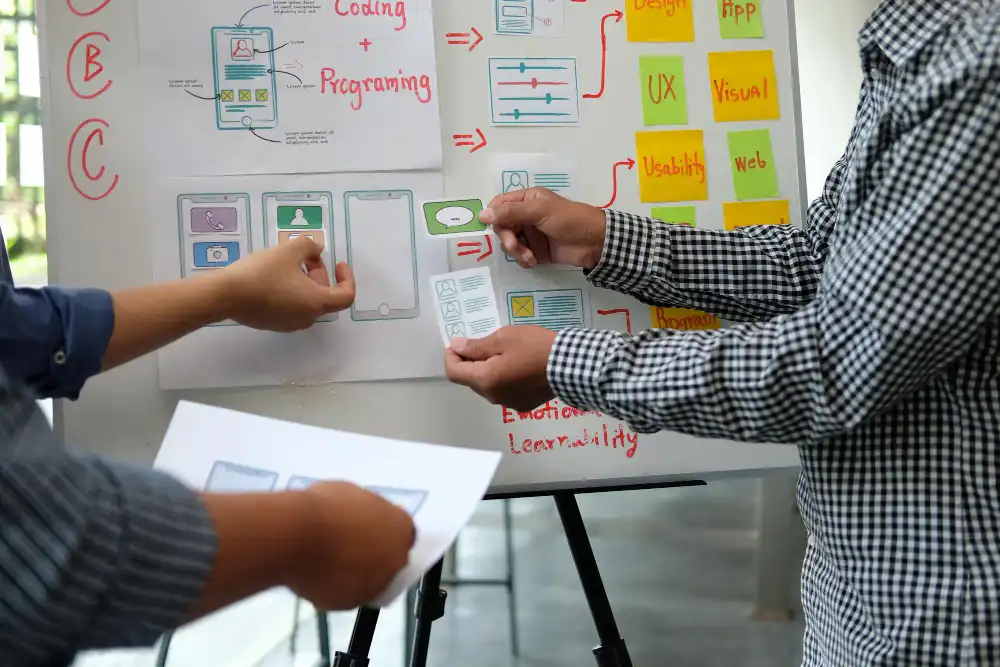
A prototype MVP means building a design that can be clicked on - typically made in applications such as Figma, or Adobe XD - to represent how the product will be used. It has screens, flows and interactions but no operating backend. It is also commonly applied during UX design and initial product development. It assists teams in exposing usability problems, verifying navigation and flow, as well as obtaining feedback on the work without requiring engineering to invest in it. The prototype MVPs can be used by means of testing the intuitive character of your product or presenting ideas to partners or investors in particular.
MVP testing strategies
After being able to select the correct type of MVP, the next thing to do is to figure out how to test it. The next MVP testing approaches would be devoted to obtaining actual user feedback, gauging interest, and revealing information that would allow you to make a decision about the further work or pivoting.
Crowdfunding
Sites such as Kickstarter and Indiegogo enable you to introduce your product concept to a wide group of people by requesting them to make real commitments either in the form of pre-orders or funds. The strategy is effective with tangible products, equipment, or innovation. An effective campaign not only proves the demand right, but also creates the initial community and brand presence. Why:
- Compares real willingness to pay
- Builds urgency and visibility
- Offers an opportunity to refine messages and positioning
Pre-orders/sing-ups
A simpler approach to crowdfunding is providing early sign-ups or pre-orders with the help of a landing page MVP. The interest in your product can be measured through the number of users who are eager to provide their mail or become a part of a waiting list or even make a pre-payment. Test page versions to identify what message best works in A/B tests to understand what helps you optimize your pitch, which is a type of split testing. Why Use It:
- Quick and cheap
- Good at testing pricing, positioning, and offers
- Is effective at testing digital products or SaaS
Customer interviews
One of the most direct MVP testing methods, interviews help you explore the motivations, behaviors, and pain points of customers. These come in particular handy at the initial phases of product development when you have not yet settled on a particular feature set. Test on them whether what you think is the reality is actually so, and what a successful MVP should be solving. Why:
- Reveals the reality of what users actually require (not what they say)
- Can help in prioritization of features
- Useful both with B2C and B2B startups
Interviews are critical in ensuring that you are aware of the problem. It is not only necessary that you should first learn about a problem before you make an effort to solve it.
MVP testing strategies
Ads
Running use Ads on Facebook, Google or LinkedIn give you an opportunity to test messaging, value propositions and audiences before creating anything. You can get traffic to a landing page MVP, waitlist, or even a survey - you will have an idea of click-through activity and conversion. This can be used to determine what your target audience likes best about your product or service. Why:
- It is the best when you want to test your idea in the market fast
- Lets you test numerous variations simultaneously
- Helps to assess the interest of various categories of customers
Bottom line
Although your product idea might be a very good one, guessing is a dangerous way to develop it. The actual worth of MVP testing is to learn quickly, early, and in a direct manner of your target audience. There are no assumptions that a strong minimum viable product is merely these launch low-cost products, but rather it means that the product has been validated and then a full build is undertaken. Regardless of the type of prototype, landing page, or concierge MVP you select, it is all aimed at the same thing to collect user feedback, test your fundamental assumptions, and determine whether your idea of a product is likely to succeed in the real world. Founders and product teams that are the most successful consider testing as a component of the development process and not a post-launch activity. That is why in case you are willing to make your MVP next level, you have no time to waste and test, validate, and create what people would want.
New to these concepts? Our glossary breaks down Validation Testing, User Feedback Integration and Minimum Viable Product.
Tags
Introduction
You must be aware that it is worth to build a new product before you build it. We must have heard the entire 9 in 10 startups fail schism. And now you see you get into the other 10%. To accomplish such, you create an MVP and test it. An MVP test is aimed at early validation of your idea by the means of a minimum viable product. You do not release a full product but publish a basic one to test one of the main assumptions. This provides you with a fast user feedback enabling you know whether your idea will solve a real problem to your target audience. But it is not as easy said and done. This paper will discuss the optimal approaches to MVP testing, tools, and strategies to test your MVP and proceed with certainty.
What is MVP validation
MVP validation is the technique of establishing the real need of your product idea, before you invest your efforts to create the actual version of your product. Beware, not every idea (at least not as it was presented in the beginning) is worth your time and life savings.
Validation of an idea can be done in other ways than through an MVP. Other than MVP, others are POC and prototypes.
What is MVP validation
It's not about polish. It's about learning. The MVP testing is aimed at ensuring that the users require what you are offering. That doesn't refer to opinions, it refers to real behavior. An effective minimum viable product has a single assumption. When that is not so, then the rest is irrelevant. Validation will save you the time and money you would have to spend on creating a product that no one desires. It also assists you to make sensible choices, and not to become emotionally involved to your idea.
Why should you test a minimum viable product
Testing MVP enables you to enter assumptions before investing in serious time and funds. It is a risk-free method of finding out whether or not your product idea has a future. Early MVP testing does not allow you to develop based on the internal bias. It provides user feedback, demonstrates interest of your target audience, and assists in making sure there is product-market fit. Concisely: test and build smarter.
What is an effective MVP
An effective minimum viable product provides a sufficient value to verify one of the major assumptions. It's not about features. It's about focus. Strong MVP:
- Resolves a single problem to your target market
- Enables you to test your MVP UX with real users fast
The point is not to impress, it is to prove your idea. And do it as fast as possible.
The best MVP testing techniques
MVP testing is not merely about creating something simple. It is an organized method to thresh out your idea, test your assumptions and make well-informed decisions about your product. This is the process involved in the MVP, the process usually goes this way:
Define Your MVP Scope
Before building, determine what your minimum viable product will and will not contain. Make one feature or issue about your product that reflects the core value of your product. Avoid overbuilding. It is aimed at providing enough to get meaningful user feedback. Ask: What is the smallest size of this product that can be used to solve a real user problem?
Define MVP success
You can never verify your idea without understanding what a success is. Have well defined and quantifiable objectives such as:
- Email signups
- Click-through rates
- Feedback volume
- Usage patterns
Link these measures to behaviour, not just opinion. It does not simply take an expression of that is cool by a user, you need verification that the user will actually utilize your product or service.
Although there exist various types of proof, there is no other way that can compare to a financial commitment.
The best MVP testing techniques
The most important thing is to know what exactly you want to know. It does not work to build an MVP as a mere point. What is the most risky and biggest of your assumptions?
Select the Right MVP Testing Methods
The manner with which you set test varies depending on what you are developing, and your target market. This is due to some MVP testing methods being more effective at testing demand (such as landing pages or advertisements); others are more effective at testing experience (such as prototyping or concierge MVPs). When possible, it is always good to have a blend of both the qualitative and quantitative testing. Qualitative results narrate true tales whereas the quantitative versions provide you with a conception of the frequency of such tales.
Test, Learn, Iterate
After your MVP is live, watch the real users interact with it. Use the user feedback as guidance, not the word of God - it is your task to discover the trend and to optimize the product based on it. The speed of the iteration is what is required to achieve a successful MVP. MVP testing marks the start of the learning loop - and not the culmination.
Start Your MVP Journey Today
Ready to validate your idea? Begin with user research and build smart, not hard.
Get StartedTypes of MVPs available
There are various types of MVP testing approaches that are applicable to various business objectives, industries and development phases. There are also ways that a product is not involved in the process. The most successful and most commonly used categories of minimum viable products are provided here and when and why they make sense is enlightened.
Piecemeal MVP
A piecemeal MVP is based on the experience of using existing tools and services and putting them together to create the appearance of a real product without writing any custom code. As an illustration, you could be using Notion to store contents, Zapier to do automation, and Typeform to collect data, provided that it works. This is the best approach to use when a startup wants to experiment with their MVP and not spend on engineering resources. It is particularly handy where the B2B has to happen or the operations are heavily weighted because even a minimal backend might cost a lot of money and take time to develop. With the help of the sewing-up of the existing platforms, the attention can be paid to the validation of the working processes, the discovery of areas of friction, and the perception of how your target audience consumes the fundamental service.
Single Feature MVP
A single-feature MVP provides a singleness core functionality - the bare minimum of a product sufficient to be standalone. The concept is to single out the most core feature in the product and determine whether the users are so interested to explore it, take it up, or make payment. This method is typical of first mover SaaS and mobile applications development where time to market matters. It enables teams to rapidly validate that their product idea is popular with users, without distraction and noise of extra features. It is also a great option when it comes to detecting usability problems or determining whether the main usage case is of any practical use.
Wizard of Oz MVP
A Wizard of Oz MVP has a product that seems to work to the consumer, yet the team operates the back-end in a manual way. As an example, an AI chatbot might seem like an automated tool, yet all the responses can be prepared by a human being. Such MVP can be used to prove the assumption of demand, workflow and user experience prior to spending on technical implementation or automation. It is usually applied to products that have AI, recommendation systems or complicated logic that would be costly to develop without guarantee of interest. The Wizard of Oz model gives you the opportunity to gather actual usage data and behavior and have complete control and flexibility on the behavior of the product.
Concierge MVP
A concierge MVP is completely manual and transparent - the users are aware that there is a human being at the end of the process. Your product or service is white-glove and high-touch, rather than automated. This is especially useful in the discovery of profound user needs and emotional motivation. Since you are working closely with users, you would be able to observe their behavior, ask follow up questions and even iterate in real time. Premium services, coaching, or early B2B solutions, in which trust, personalization, and insight are more important than automation, tend to be offered through concierge MVPs.
Explainer Video MVP
Explainer video MVP shows your idea before you have created anything. It will explain what the product idea is, how it functions, and what value is offered by it - usually in less than two minutes. The traditional case model is the Dropbox that tested the demand of its product with the help of a simple demonstration video. Thousands registered a product that was not even built yet, which demonstrated the desire of the market and formed the build of the future. This kind of MVP is the best to investigate clarity and appeal. It works best when you are trying to prove that your assumptions about whether or not your solution is understood by potential users and that they are excited about the idea.
Landing Page MVP
A landing page MVP is a simple webpage, which conveys your value proposition, and asks users to perform a particular action, such as signing up, joining a waitlist or showing interest. You will have the ability to place advertisements or to redirect traffic to the page and monitor such measurements as a bounce rate, click-through rate, or form submissions. It is a quick and cheap means of positioning as well as testing the interest in your product and segmenting your target market. This approach is good with consumer and B2B products and can be implemented in hours with the help of Webflow, Carrd, or Unbounce.
Prototype MVP
A prototype MVP means building a design that can be clicked on - typically made in applications such as Figma, or Adobe XD - to represent how the product will be used. It has screens, flows and interactions but no operating backend. It is also commonly applied during UX design and initial product development. It assists teams in exposing usability problems, verifying navigation and flow, as well as obtaining feedback on the work without requiring engineering to invest in it. The prototype MVPs can be used by means of testing the intuitive character of your product or presenting ideas to partners or investors in particular.
MVP testing strategies
After being able to select the correct type of MVP, the next thing to do is to figure out how to test it. The next MVP testing approaches would be devoted to obtaining actual user feedback, gauging interest, and revealing information that would allow you to make a decision about the further work or pivoting.
Crowdfunding
Sites such as Kickstarter and Indiegogo enable you to introduce your product concept to a wide group of people by requesting them to make real commitments either in the form of pre-orders or funds. The strategy is effective with tangible products, equipment, or innovation. An effective campaign not only proves the demand right, but also creates the initial community and brand presence. Why:
- Compares real willingness to pay
- Builds urgency and visibility
- Offers an opportunity to refine messages and positioning
Pre-orders/sing-ups
A simpler approach to crowdfunding is providing early sign-ups or pre-orders with the help of a landing page MVP. The interest in your product can be measured through the number of users who are eager to provide their mail or become a part of a waiting list or even make a pre-payment. Test page versions to identify what message best works in A/B tests to understand what helps you optimize your pitch, which is a type of split testing. Why Use It:
- Quick and cheap
- Good at testing pricing, positioning, and offers
- Is effective at testing digital products or SaaS
Customer interviews
One of the most direct MVP testing methods, interviews help you explore the motivations, behaviors, and pain points of customers. These come in particular handy at the initial phases of product development when you have not yet settled on a particular feature set. Test on them whether what you think is the reality is actually so, and what a successful MVP should be solving. Why:
- Reveals the reality of what users actually require (not what they say)
- Can help in prioritization of features
- Useful both with B2C and B2B startups
Interviews are critical in ensuring that you are aware of the problem. It is not only necessary that you should first learn about a problem before you make an effort to solve it.
MVP testing strategies
Ads
Running use Ads on Facebook, Google or LinkedIn give you an opportunity to test messaging, value propositions and audiences before creating anything. You can get traffic to a landing page MVP, waitlist, or even a survey - you will have an idea of click-through activity and conversion. This can be used to determine what your target audience likes best about your product or service. Why:
- It is the best when you want to test your idea in the market fast
- Lets you test numerous variations simultaneously
- Helps to assess the interest of various categories of customers
Bottom line
Although your product idea might be a very good one, guessing is a dangerous way to develop it. The actual worth of MVP testing is to learn quickly, early, and in a direct manner of your target audience. There are no assumptions that a strong minimum viable product is merely these launch low-cost products, but rather it means that the product has been validated and then a full build is undertaken. Regardless of the type of prototype, landing page, or concierge MVP you select, it is all aimed at the same thing to collect user feedback, test your fundamental assumptions, and determine whether your idea of a product is likely to succeed in the real world. Founders and product teams that are the most successful consider testing as a component of the development process and not a post-launch activity. That is why in case you are willing to make your MVP next level, you have no time to waste and test, validate, and create what people would want.
New to these concepts? Our glossary breaks down Validation Testing, User Feedback Integration and Minimum Viable Product.
Tags